FLSA · 2026 US PAYROLL
US Overtime Pay Calculator
Calculate 1.5x overtime and 2.0x double-time gross pay from hourly wages or non-exempt salaries with itemized paystub totals.
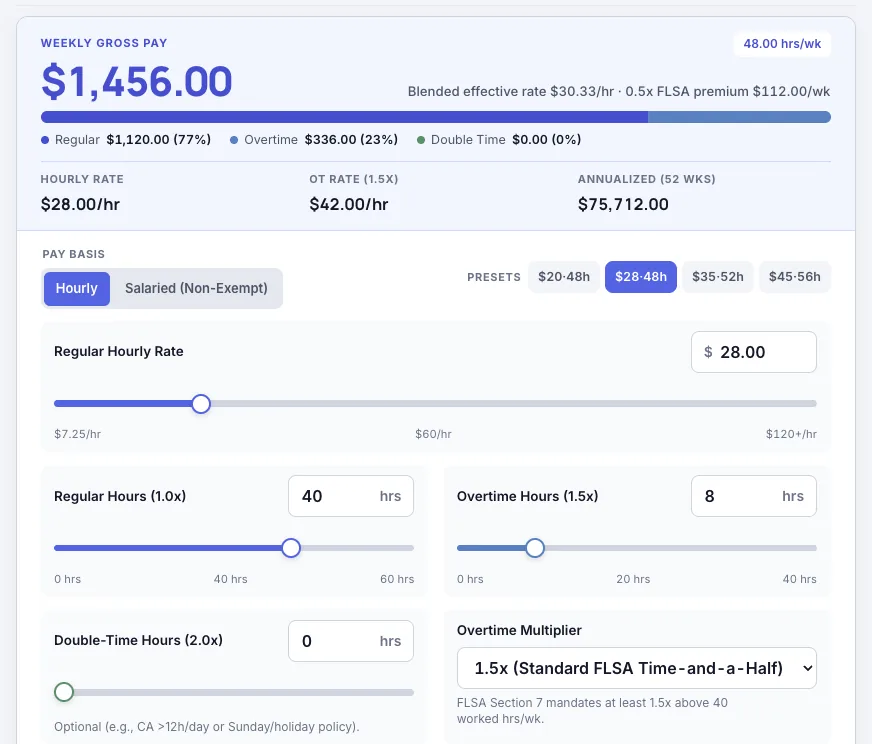
Blended effective rate $30.33/hr · 0.5x FLSA premium $112.00/wk
Pay Rate and Weekly Hours Controls
Itemized Gross Paystub Paystub Details
| Earnings Line | Hours | Rate | Subtotal |
|---|---|---|---|
| Regular Pay (1.0x) | 40.00 | $28.00 | $1,120.00 |
| Overtime Pay (1.5x) | 8.00 | $42.00 | $336.00 |
| Double-Time Pay (2.0x) | 0.00 | $56.00 | $0.00 |
| Weekly Gross Total | 48.00 | $30.33 | $1,456.00 |
| FLSA 0.5x Overtime Premium Portion (Hours >40/wk, for 2026 Tax Deduction) | $112.00 | ||
Side-by-Side Pay Scenarios 0 / 4
| Shift / Offer Scenario | Weekly Gross | Blended Rate | 0.5x OT Prem. | Annual Gross | Actions |
|---|
Am I FLSA Overtime Exempt? (3-Question Quick-Checker)
Under federal law, an employee is exempt from 1.5x overtime only if all three Fair Labor Standards Act tests are satisfied. Toggle each prong below for an instant screen.
Likely Non-Exempt — Eligible for 1.5x Overtime Pay
Under federal FLSA rules, an employee must satisfy all three tests to be exempt. Because not paid on a guaranteed salary basis and primary duties do not meet the Executive, Administrative, or Professional (EAP) test, you are generally eligible for at least 1.5x overtime pay after 40 hours worked in a workweek.
DOL Reference Note: Based on US Department of Labor Wage and Hour Division Fact Sheet #17A (29 CFR Part 541). Educational screening tool only—not legal advice. Certain roles (outside sales, specific computer/IT professionals, or motor-carrier workers) follow separate statutory tests, and states such as California and New York set higher exempt salary floors.
Worked US Overtime Paystub Examples
Each row below applies the federal FLSA 1.5x formula (and 2.0x double time where noted) with cent-accurate line rounding so regular, overtime, and weekly gross totals reconcile penny-for-penny.
| Worker Scenario | Base Rate | 1.5x Rate | Regular Pay | OT + DT Pay | Weekly Gross | Annual (52 Wks) |
|---|---|---|---|---|---|---|
| Retail / Warehouse ($18/hr · 45h) | $18.00 | $27.00 | $720.00 | $135.00 | $855.00 | $44,460.00 |
| Trades / Technician ($28/hr · 48h) | $28.00 | $42.00 | $1,120.00 | $336.00 | $1,456.00 | $75,712.00 |
| Registered Nurse ($42/hr · 40h + 8h OT + 4h DT) | $42.00 | $63.00 | $1,680.00 | $840.00 | $2,520.00 | $131,040.00 |
| Salaried Non-Exempt ($62,400/yr · 46h) | $30.00 | $45.00 | $1,200.00 | $270.00 | $1,470.00 | $76,440.00 |
FLSA Overtime Formula & Scope Limitations
Under Section 7 of the Fair Labor Standards Act (U.S. Department of Labor FLSA Overtime Guidance and 29 CFR Part 778), covered non-exempt employees must receive at least 1.5 times their regular rate of pay for all hours worked beyond 40 in a single 7-day workweek.
Overtime Pay (1.5x) = Base Rate × 1.5 × Overtime Hours
Double-Time Pay (2.0x) = Base Rate × 2.0 × Double-Time Hours
Salaried Non-Exempt Base Rate = Annual Salary ÷ (52 × Standard Weekly Hours)
What This Estimator Does Not Model
- Gross Pay Only: Outputs show pre-tax gross wages before federal/state income tax withholding, FICA (Social Security up to the 2026 SSA $184,500 wage base and Medicare), health insurance, or 401(k) deductions. To estimate 2026 federal tax savings on your overtime premium, open the 2026 No Tax on Overtime Calculator.
- Nondiscretionary Bonuses & Multiple Rates: Under 29 CFR § 778.115 and § 778.209, production bonuses, shift differentials, and multiple job rates change your legal FLSA regular rate. Use our Weighted Overtime Calculator or Shift Differential Calculator for those paystubs.
- State Daily Overtime Laws: California, Alaska, Nevada, and Colorado require daily overtime after 8 or 12 hours in a single workday. California workers should switch to our California Overtime Calculator.
Frequently Asked Questions
Does federal overtime start after 8 hours in a day or 40 hours in a week?
Under the federal Fair Labor Standards Act (29 U.S.C. § 207), overtime applies only after 40 hours actually worked in a single 7-day workweek, regardless of daily shift length. Only a handful of states—including California, Alaska, Nevada, and Colorado—impose mandatory daily overtime thresholds.
How do you convert an annual salary to an hourly overtime rate for non-exempt employees?
Divide the annual base salary by 52 weeks, then divide by the employee’s regular weekly schedule (normally 40 hours, or 2,080 hours per year). A $62,400 non-exempt salary equals $30.00/hr straight time and $45.00/hr at 1.5x overtime.
Do paid vacation, sick leave, or paid holidays count toward the 40-hour FLSA overtime threshold?
No under federal law. The FLSA counts only hours physically worked. If you take 8 hours of paid time off on Monday and work 36 hours Tuesday through Friday (44 paid hours total), federal law requires straight-time pay for all 44 hours unless your employer policy or union contract counts PTO toward overtime.
Are overtime earnings taxed at a higher federal rate than regular wages?
Overtime wages are taxed under the exact same federal income tax brackets as regular wages. They can look more heavily taxed on a single paycheck because payroll withholding software annualizes that larger check, and any excess withholding is refunded when you file Form 1040. For tax years 2025–2028, qualifying workers can also deduct the 0.5x FLSA overtime premium on our 2026 No Tax on Overtime Calculator.
When should I use the Weighted Average or California calculators instead of this standard calculator?
Use this page when you earn one flat base rate under standard weekly overtime rules. If you worked two or more different pay rates in the same week, use our FLSA Weighted Average Overtime Calculator. If you work in California and logged over 8 hours in a single day or worked 7 consecutive days, use our California Overtime Calculator.